How to Buy a House With a Low Down Payment: The Complete Process
Three-percent-down, 3.5%-down and zero-down loan programs all exist — here is what each one demands of your credit, income and paperwork.
By Desmond Achebe-Park · Oct 06, 2026 · 13 min read

You do not need 20% down to buy a house. Conventional programs from Fannie Mae and Freddie Mac go to 3% down, FHA goes to 3.5% with a 580 credit score, and VA and USDA loans go to zero down for buyers who meet their eligibility rules. What a low down payment does change is the paperwork, the mortgage insurance, the loan limit you are held to, and how much cash you need on hand if an appraisal comes in low.
This guide walks the process from first credit pull through recording of the deed, names the documents and the people involved at each stage, and shows where the numbers shift by metro, loan type and property type.
Overview
Start with the numbers you can actually verify, then replace them with your own market's figures before you commit to anything.
Nationally, the 30-year fixed-rate mortgage averaged 7.28% as of October 1, 2026, up from 7.03% the week before, and the 15-year fixed averaged 6.60% in the same weekly survey (Freddie Mac, 2026-10-01). The median existing-home sales price was $429,100 in August, up 1.6% year over year (National Association of Realtors, 2026-09-10). Unsold inventory rose to 1.62 million units, or 4.9 months' supply — the highest level in over a decade — while existing-home sales fell to a seasonally adjusted annual rate of 3.98 million, down 2.0% month over month and 1.2% year over year (National Association of Realtors, 2026-09-10).
Those are national figures. They are not your market. Inventory, median price and days on market vary sharply between metros and between submarkets inside the same metro, and condos often behave differently from single-family homes in the same ZIP code. Before you decide anything, pull three local numbers: months' supply and median sale price for your price band from your local Realtor association or MLS market report, and a current rate quote for your credit score, loan type and loan amount from at least two lenders. A national rate average is a survey of advertised conventional loans — it is not an offer, and your FHA, VA or jumbo quote will differ.
What a higher-inventory market tends to mean for a low-down-payment buyer is more room to ask for repairs or seller-paid closing costs, and less pressure to waive contingencies. What it does not mean is that any particular home will sell at a particular price or in a particular number of days. Check whether your metro's inventory is actually rising before you assume you have leverage.
The Home-Buying Process
- Pull your own credit and set your program target. Your middle FICO score decides which doors are open: 620 is the minimum for Fannie Mae HomeReady, along with income at or below 80% of area median income and a debt-to-income ratio no higher than 50% (The Mortgage Reports, undated); FHA goes to 3.5% down at 580, or 10% down at 500–579 (The Mortgage Reports, undated). Do this 60–90 days before you shop, because correcting a reporting error through the bureaus takes weeks, not days.
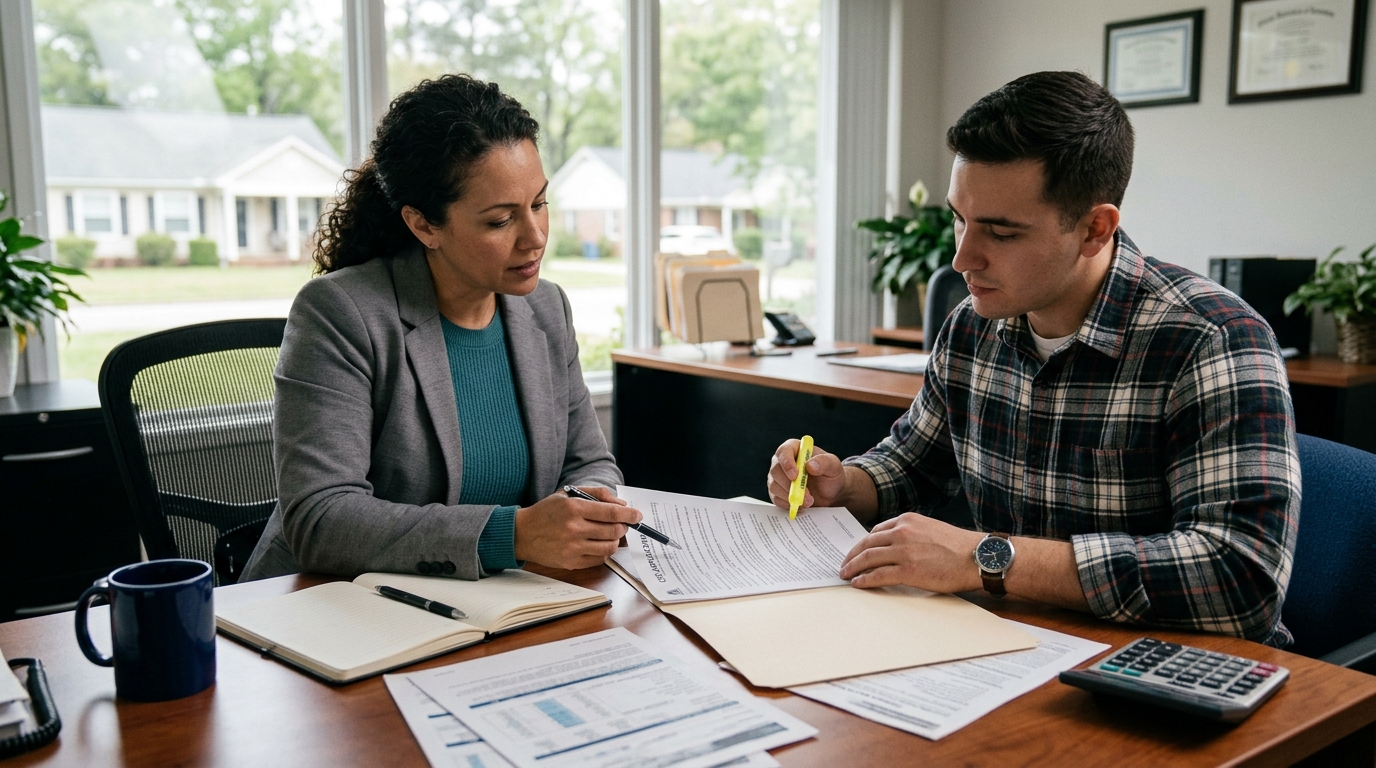
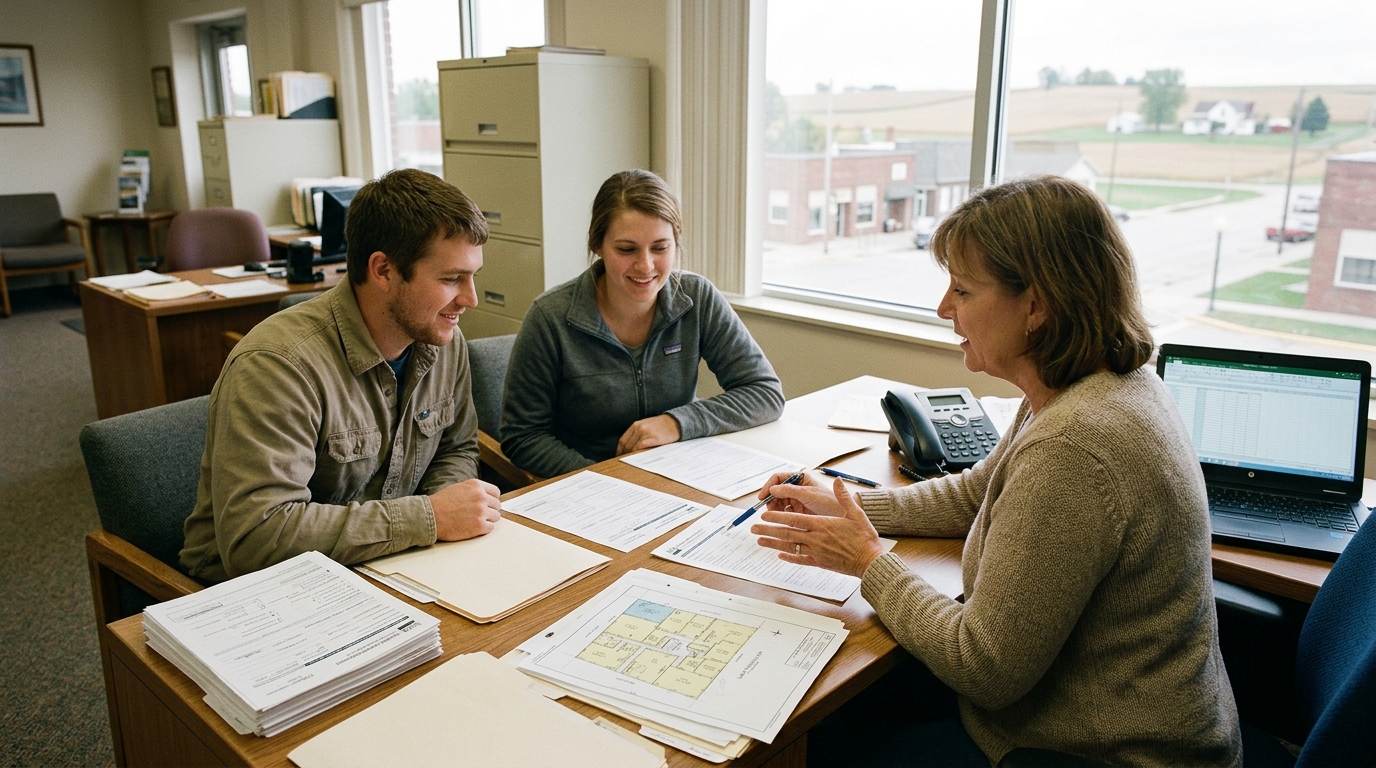
- Interview two or three loan officers and submit a full application. The document is the 1003 Uniform Residential Loan Application. Ask each lender which low-down-payment products they actually deliver: HomeReady, Freddie Mac Home Possible (also 3% down for moderate- and low-income buyers, per The Mortgage Reports, 2026), FHA, VA, USDA Rural Development, and any down payment assistance run by your state housing finance agency. Not every lender offers all of them.
- Compare Loan Estimates side by side. Each lender issues a Loan Estimate on a standard form after you apply; it shows the rate, the monthly payment, mortgage insurance and itemized closing costs. Compare them within the same few days, because quotes move with the market — the 30-year average rose a quarter point in a single week (Freddie Mac, 2026-10-01). Expect this stage to take one to two weeks.
- Clear your program's special requirements early. HomeReady borrowers must complete a homeownership education course (The Mortgage Reports, undated) — allow a few hours to a few days and keep the certificate. VA borrowers need a valid Certificate of Eligibility and must meet credit, income and occupancy requirements (Military.com, undated). USDA borrowers need the property to sit in an eligible area: USDA treats an area as rural at 10,000 residents or fewer, at 10,001–20,000 outside a Metropolitan Statistical Area with a serious lack of affordable mortgage credit, or at 20,001–35,000 where rural status was lost in the 1990, 2000 or 2010 Census (Neighbors Bank, 2026).
- Get a written preapproval, then hire a buyer's agent. You will sign a buyer representation agreement setting the agent's compensation and term. Tell the agent your loan type up front — FHA, VA and USDA all carry property condition standards that rule out some listings.
- Write the offer on your state's purchase agreement. It names the price, the earnest money amount, the financing and appraisal contingencies, the inspection period in days, and the closing date. Your earnest money goes to the escrow officer at the title company or to the closing attorney, depending on which system your state uses — not to the seller.
- Order the home inspection inside the inspection deadline. You hire a licensed or certified home inspector directly; the written inspection report is yours. Inspection periods are counted in days from acceptance and are short, so book the inspector the day the contract is signed. Add specialty inspections — sewer scope, roof, pest, radon — if the report flags them.
- The lender orders the appraisal; you do not. VA loans require a VA appraisal confirming Minimum Property Requirements (Military.com, undated). Turnaround depends on appraiser availability in your county and typically runs one to three weeks. If the appraised value lands below your contract price, the lender lends against the lower number.
- Work through underwriting conditions. Underwriting will ask for updated pay stubs, a verification of employment, a signed gift letter and donor bank statements if any funds are gifted, and explanations for any large deposits. Answer every condition the same day you receive it; this stage is the usual cause of delayed closings.
- Review the Closing Disclosure, do the final walkthrough, then sign. The Closing Disclosure sets out the final cash to close and should be compared line by line against your last Loan Estimate. Walk the property after the sellers move out. At signing, the escrow officer or closing attorney handles funds and sends the deed to the county recorder's office; recording is what makes it public. From accepted offer to recording, a straightforward low-down-payment purchase commonly runs four to six weeks, longer for condos needing project review or for VA and USDA files.
Typical Costs and Timeline
Dollar figures below are only the ones that can be sourced. Everything else varies by county, title company and property type, and you should get it in writing locally — call the title company or closing attorney for settlement fees, and check your county recorder's published fee schedule for recording costs.
| Item | Amount, with source | When it happens |
|---|---|---|
| HomeReady / Home Possible down payment | 3% of the purchase price, with no minimum personal contribution required and funding allowed from gifts, grants and Community Seconds (Fannie Mae, undated); 3% is about half the average down payment and equals $6,000 on a $200,000 home (The Mortgage Reports, 2026) | Due as certified funds or wire at closing |
| FHA down payment | 3.5% at a credit score of 580 or higher (PennyMac, undated); 10% at scores of 500–579 (The Mortgage Reports, undated) | Due at closing |
| VA down payment and funding fee | $0 down with no mortgage insurance for eligible service members, Veterans and some surviving spouses (Freedom Mortgage, undated); example first-time-buyer funding fee of 2.15%, financed into the loan (Military.com, undated) | Fee is financed, not paid in cash |
| USDA Rural Development down payment | 0% down, up to 100% financing, with low upfront and annual fees in place of mortgage insurance and no maximum purchase price, as a 30-year fixed (Neighbors Bank, 2026; United Federal Credit Union, undated) | Fee financed into the loan |
| Maximum loan size | Conforming limits of $832,750 to $1,249,125 (The Mortgage Reports, undated); FHA single-family limits of $541,287 to $1,249,125 in higher-cost areas (The Mortgage Reports, undated) | Confirmed at preapproval |
| Interest rate benchmark | 30-year fixed averaged 7.28%; 15-year fixed averaged 6.60% (Freddie Mac, 2026-10-01) | Lock window set by your lender, usually 30–60 days |
| Earnest money | Negotiated and written into the purchase agreement; held by the escrow officer or closing attorney, not the seller | Delivered within the days stated in the contract after acceptance |
| Home inspection | Quoted by the inspector you hire; get the fee and scope in writing before booking | Booked immediately after acceptance; report usually back in 24–72 hours |
| Appraisal | Ordered and billed by the lender; the fee appears on your Loan Estimate | Commonly one to three weeks, depending on appraiser availability |
| Title, settlement and recording | Quoted by the title company or closing attorney; recording fees set by the county recorder's published schedule | Charges appear on the Closing Disclosure before signing |
Timeframes above are ordinary process durations, not survey results, and they stretch in markets with appraiser shortages, on condos requiring project review, and on VA and USDA files.
Documents You'll Need
Gather these before you apply, not after underwriting asks. Scan every page, including blank ones, because lenders reject partial statements.
- Signed 1003 Uniform Residential Loan Application
- Driver's license or passport, and your Social Security number
- W-2s for the last two years
- Federal tax returns (Form 1040) for the last two years with all schedules
- Your two most recent pay stubs showing year-to-date earnings
- Two months of bank statements for every account holding funds for the purchase, all pages
- Two months of statements for any retirement or brokerage account you plan to draw on
- Signed gift letter from the donor, plus the donor's bank statement and proof of transfer — relevant because HomeReady permits gifts, grants and Community Seconds with no minimum personal contribution (Fannie Mae, undated)
- Homeownership education completion certificate, required for HomeReady (The Mortgage Reports, undated)
- Certificate of Eligibility (COE) and DD-214 or current statement of service for a VA loan (Military.com, undated)
- Documentation of the property's USDA eligibility if you are using Rural Development financing (Neighbors Bank, 2026)
- If self-employed: two years of 1099s or K-1s, a year-to-date profit and loss statement, and two months of business bank statements
- Letters of explanation for any deposit that does not match a pay stub
- Divorce decree, separation agreement or child support order, if either affects your income or debts
- Bankruptcy discharge papers or foreclosure documents, if applicable
- Twelve months of canceled rent checks or a landlord payment history if your credit file is thin
- Fully executed purchase agreement and the escrow officer's earnest money receipt
- Homeowners insurance declarations page naming the lender
- For condos: the HOA budget, master insurance certificate, CC&Rs and the completed condo questionnaire your lender sends to the association
- At closing: the Closing Disclosure, the appraisal report, the title commitment or preliminary title report, your photo ID, and wire confirmation or a cashier's check for cash to close
A licensed loan officer, your agent and a closing attorney where your state uses one will tell you which of these your specific file needs. This list is a starting point, not legal or tax advice on your transaction.
Frequently asked questions
How much earnest money should I offer, and can I get it back?
There is no fixed amount — the figure is negotiated and written into the purchase agreement, and it is held by the escrow officer at the title company or by the closing attorney, never by the seller directly. Refundability depends entirely on the contingency deadlines in your contract: cancel inside the inspection, appraisal or financing deadline in the manner the contract requires and the deposit is normally returned, usually after both parties sign mutual release instructions. Earnest money is not extra money — it is credited toward your cash to close. On a 3% HomeReady down payment, which is $6,000 on a $200,000 home (The Mortgage Reports, 2026), any earnest money you put up is part of that $6,000, not on top of it.
What happens if the appraisal comes in below my offer price?
Your lender lends against the lower of appraised value or contract price, so the gap becomes cash you must bring. This hits low-down-payment buyers hardest: if you are putting 3% down under Fannie Mae HomeReady (Fannie Mae, undated), a shortfall can easily exceed your entire down payment. Your options are to renegotiate the price, pay the difference in cash if your contract allows, request reconsideration of value through the lender with better comparable sales, or cancel under an appraisal contingency. VA buyers have a separate issue: the VA appraisal also checks Minimum Property Requirements, and a property that fails them cannot close until the problems are fixed (Military.com, undated).
Do I have to pay mortgage insurance with a low down payment?
It depends on the loan. VA loans require no mortgage insurance at all for eligible Veterans, active-duty, reserve and National Guard members and some surviving spouses, and allow a $0 down payment (Freedom Mortgage, undated); instead there is a funding fee, shown as 2.15% for a first-time buyer in one lender comparison and financed into the loan (Military.com, undated). USDA Rural Development loans charge low upfront and annual fees in place of mortgage insurance with 0% down (Neighbors Bank, 2026). Conventional 3%-down loans such as HomeReady and Home Possible carry private mortgage insurance until you reach the equity threshold your servicer applies, and FHA carries its own mortgage insurance premiums. Ask each lender to show the monthly mortgage insurance line on the Loan Estimate.
What credit score do I actually need?
620 is the minimum for Fannie Mae HomeReady, alongside a debt-to-income ratio no higher than 50% and completion of a homeownership education course (The Mortgage Reports, undated). FHA sets a lower floor: 580 qualifies you for the 3.5% down payment, and scores of 500–579 require 10% down (The Mortgage Reports, undated; PennyMac, undated). Individual lenders can and do impose overlays above those minimums, so a 600 score may be approvable at one lender and declined at another. Nobody can promise you approval or a specific rate before your file is underwritten.
Can my whole down payment be a gift from family?
Under Fannie Mae HomeReady, yes — the program requires no minimum personal contribution and allows funding from gifts, grants and Community Seconds (Fannie Mae, undated). What underwriting requires is a paper trail: a signed gift letter stating the money is not a loan, the donor's bank statement showing the funds, and proof of the transfer into your account. Deposit the gift as a single traceable transfer rather than cash, and do it early — unexplained deposits in your last two months of bank statements will stall the file.
Is there a price cap on low-down-payment loans?
Yes, for most of them. Conventional 3%-down loans must fall within conforming loan limits, which run from $832,750 to $1,249,125 depending on the county (The Mortgage Reports, undated). FHA single-family limits range from $541,287 to $1,249,125 in higher-cost areas (The Mortgage Reports, undated), so an FHA purchase in an expensive metro can be capped well below the local median. USDA Rural Development is the exception — it offers up to 100% financing with no maximum purchase price as a 30-year fixed (United Federal Credit Union, undated) — but the property must sit in a USDA-eligible area, which USDA defines by population bands starting at 10,000 residents or fewer (Neighbors Bank, 2026). Check your county's limit with a loan officer before you set a search range.
Sources
- Freddie Mac — Mortgage Rates - Freddie Mac (PMMS) (2026-10-01)
- National Association of Realtors (NAR) — NAR Existing-Home Sales Report Shows 2.0% Decrease in August (2026-09-10)
- Fannie Mae — HomeReady Mortgage | Fannie Mae
- The Mortgage Reports — 3% Down Payment Mortgages for First-Time Home Buyers
- The Mortgage Reports — Fannie Mae HomeReady Income Limits | 2026 (2026)
- The Mortgage Reports — FHA Loan Guide
- PennyMac — FHA Loan Credit Score Requirements: What You Need to Qualify
- Freedom Mortgage — VA Loans Explained: What They Are and How They Work
- Military.com — VA Loan for First-Time Home Buyers: The Zero-Down Advantage Explained
- Neighbors Bank — 2026 USDA Eligibility Map & Rural Property Requirements (2026)
- United Federal Credit Union — Rural Development Mortgage Loan

Written by
Desmond Achebe-Park
Desmond covers the renter's side of the market, from lease fine print to the etiquette of negotiating with landlords. He's interested in how small cities absorb people priced out of bigger ones. He writes with a skeptic's eye toward anything called a 'luxury amenity.'