Should You Sell With an Agent or On Your Own? Costs and Trade-Offs Compared
Compare listing-side fees, buyer-side concessions, closing timelines and what actually lands in your pocket before you sign with anyone.
By Desmond Achebe-Park · Oct 06, 2026 · 10 min read
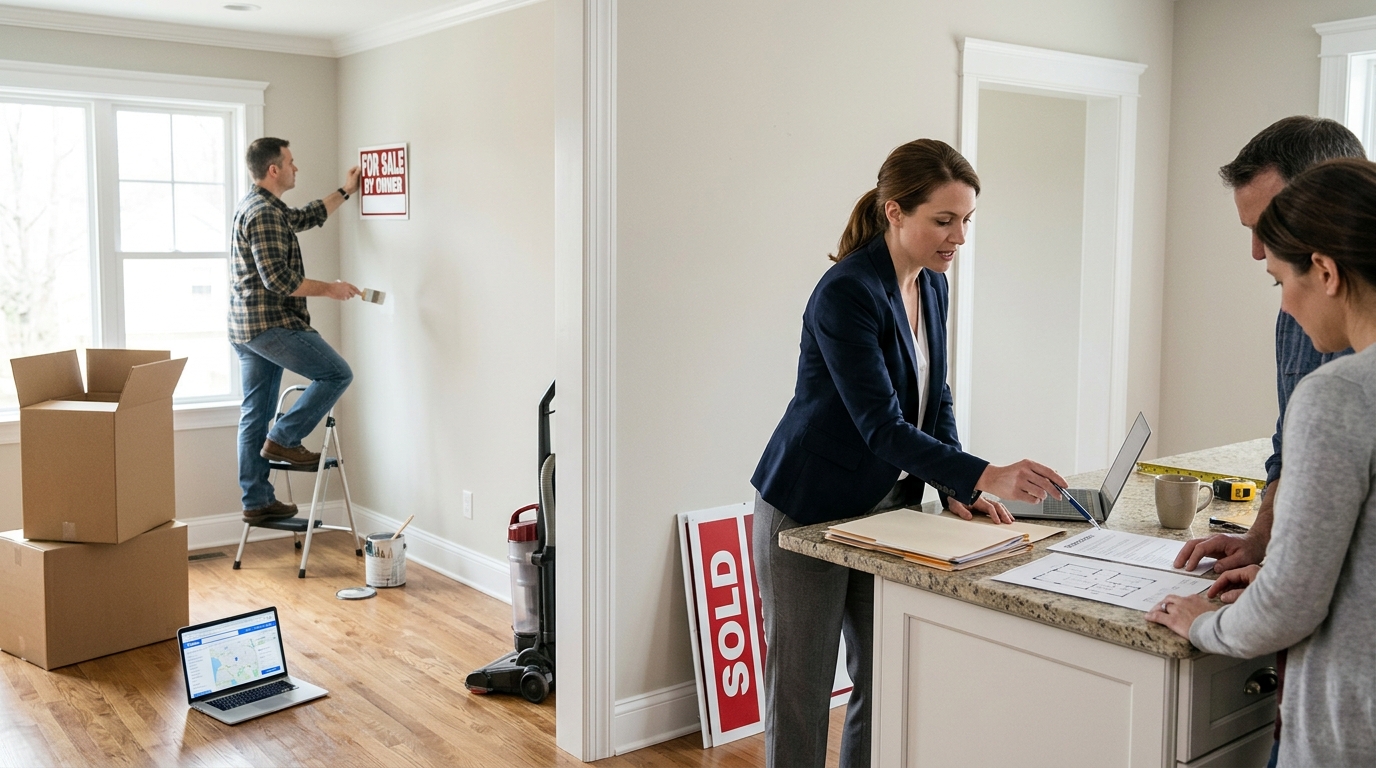
Three routes get a house sold: list with a full-service agent, sell it yourself (FSBO), or sell direct to an iBuyer or cash buyer. They differ on what you pay, how fast you close, and — the part that matters — what you net after every deduction. Most sellers still use an agent or broker, and the FSBO share fell to a historic low in the National Association of Realtors' 2024 survey (National Association of Realtors, 2024-11), but "most people do it" isn't a reason, and neither is a low advertised fee.
Use the sections below to build your own side-by-side. The only honest comparison is the bottom line on a settlement statement, and every number in it is quoted to you in writing before you sign — so treat this as the template you fill with real quotes from a listing agent, a title company, and at least two cash buyers.
Selling Options Compared
Fees, speed and net proceeds move in opposite directions. Lower fee usually means more work or a lower offer; faster close usually means a fee or a price haircut. Here is how the three routes differ on each.
| Method | Fee you pay | Typical time to close | Net proceeds impact |
|---|---|---|---|
| Full-service listing agent | Listing-side commission, negotiable within the range Zillow describes for this closing-cost line item (Zillow, 2024-11-21), plus you decide separately whether to offer a buyer-side concession — the average U.S. buyer's agent commission rose year over year in Q2 2025 (Redfin, reported by CNBC, 2025-08-26) | Marketing period (set by your local inventory and days-on-market, not a national rule) plus the buyer's financing: Opendoor describes a typical accepted-offer-to-keys window for a financed closing (Opendoor, undated); appraisal and underwriting drive it | Highest gross price potential from open-market bidding, but the most deductions: both commission sides, seller closing costs, prep, and the repair or concession credit buyers commonly request after inspection (Offerpad, 2026-02-12) |
| FSBO (for sale by owner) | No listing-side commission; you still pay title, escrow, transfer taxes and recording, and you choose whether to offer a buyer-side concession — relevant because most buyers use an agent or broker (National Association of Realtors, 2024-11) | Same financed-closing timeline as an agent sale once you're under contract; the variable is how long it takes you to find the buyer — near zero if you already have one, open-ended if you don't | Saves the listing-side fee, but NAR's 2024 Profile compared median sale prices for agent-assisted versus FSBO homes (Virginia REALTORS, 2024-12-09) and the groups aren't like-for-like: many FSBO sales go to a known buyer at an off-market price |
| iBuyer / direct cash buyer | A stated service fee plus closing costs — Offerpad charges a service fee plus closing costs and compares that total to a traditional sale (Offerpad, 2026-02-12); Opendoor's service fee is variable (Real Estate Witch, undated) | Fastest and most controllable: a seller-chosen date inside a set window (Offerpad, 2026-02-12), with a maximum wait after contract date (Opendoor, 2026-08-10); no appraisal or loan underwriting to fail | Offer is typically below what open-market bidding might produce, and repair deductions come off the offer — but you avoid the buyer concession credit commonly requested in a traditional sale (Offerpad, 2026-02-12), plus prep and carrying costs |
Two in-between routes exist: flat-fee MLS listings (you pay a set fee for MLS exposure and handle the rest yourself) and limited-service or discount brokerages. Both sit between FSBO and full service on fee and on how much of the work lands on you.
Costs Side by Side
Work one sale price across all three columns. This example uses a $362,000 sale price, the home price Zillow uses in its seller closing-cost example (Zillow, 2024-11-21). Every line appears in every column so nothing hides.
| Line item | Full-service agent | FSBO | iBuyer / cash buyer |
|---|---|---|---|
| Gross sale price or offer | $362,000 open-market price | $362,000 if you achieve the same price; NAR's 2024 Profile compared agent-assisted and FSBO median prices (Virginia REALTORS, 2024-12-09) | Cash offer on $362,000 of value, typically quoted below an open-market list price |
| Listing-side commission | $362,000 × the rate in your listing agreement; negotiable within the range Zillow cites for this line (Zillow, 2024-11-21) | $0 | $0 |
| Buyer-side commission or concession | $362,000 × whatever you agree to offer; U.S. average rose year over year in Q2 2025 (Redfin, via CNBC, 2025-08-26) | $0 if the buyer pays their own agent; otherwise the same calculation — most buyers come with an agent (National Association of Realtors, 2024-11) | $0 |
| Platform or service fee | $0 | $0, or a flat MLS listing fee if you buy exposure | Offerpad: stated service fee plus closing costs (Offerpad, 2026-02-12); Opendoor: variable service fee (Real Estate Witch, undated) |
| Title insurance | Quoted by your title company; Zillow lists it as a standard seller closing-cost line (Zillow, 2024-11-21) | Same quote, same amount | Same line, unless the buyer's program covers it — get it in writing |
| Other closing costs (transfer tax, escrow, recording, prorated taxes, HOA transfer fee) | Set by state and county law and your HOA documents | Identical — these don't change with selling method | Identical, unless the offer specifies who pays which |
| Repair credit or buyer concession | Post-inspection credit; Offerpad cites a typical seller concession requested in traditional sales (Offerpad, 2026-02-12) | Same exposure; buyers inspect regardless of who lists | Deducted from the offer as a repair adjustment instead of a credit (Offerpad, 2026-02-12) |
| Prep, staging, photography, cleaning | Your spend, quoted by vendors | Your spend, plus any marketing you buy | Usually none — the point of the route |
| Carrying costs while on market | Mortgage, taxes, insurance, utilities × months on market in your submarket | Same, and potentially longer if you have no buyer yet | Shortest, bounded by the closing window (Offerpad, 2026-02-12; Opendoor, 2026-08-10) |
| Net proceeds before mortgage payoff | Sale price minus every line above | Sale price minus every line above | Offer minus every line above |
Zillow describes a typical total range for seller closing costs including commissions and associated fees, worked on a $362K home (Zillow, 2024-11-21) — read the current figure at the source and compare it against your own quotes.
Three quotes make the table real: a listing presentation with the commission written in, a title company estimated settlement statement, and offers from at least two cash buyers. Compare the bottom row only. A column with the lowest fee line can still finish last.
Who Each Option Fits Best
- Full-service agent — fits when your home needs open-market exposure to find its price, you can fund prep and showings before closing, and your equity covers commission plus seller closing costs out of proceeds without bringing cash to the table. Run the test: subtract your mortgage payoff and the full closing-cost range (Zillow, 2024-11-21) from a realistic sale price. If the result is positive and you can carry the mortgage, taxes, insurance and utilities through your submarket's current median days on market plus the buyer's underwriting period, this route works. Most sellers use an agent or broker (National Association of Realtors, 2024-11); that's context, not a recommendation for your situation.
- FSBO — fits when the buyer already exists: a tenant, neighbor, relative or co-owner. A notable share of FSBO sellers already knew their buyer (National Association of Realtors, 2024-11), and the FSBO share overall fell to a historic low in that survey (National Association of Realtors, 2024-11), which tells you how hard the cold-start version is. It also fits when thin equity means listing-side commission would force you to bring cash to closing. In either case, budget for a real estate attorney or title company to handle the contract, your state's required disclosures, and escrow — those costs don't disappear with the commission.
- iBuyer or direct cash buyer — fits when the deadline is fixed and expensive: a job start date, a purchase contract on the next house, an inherited property you're paying to hold, or a home needing repairs you can't fund before closing. You get a seller-chosen date inside a set window (Offerpad, 2026-02-12) or a capped wait after contract (Opendoor, 2026-08-10), and no financing contingency to collapse. It fits only if your equity absorbs both the service fee and an offer below open-market pricing. These buyers also restrict which metros, property types and conditions they'll purchase — condos with HOA restrictions and homes with structural or permitting issues are frequently excluded.
If none fits cleanly, a flat-fee MLS listing or a limited-service brokerage gives you exposure without full listing-side commission, with more of the disclosure and negotiation work on you.
Frequently asked questions
Is an iBuyer offer negotiable?
The initial price is usually take-it-or-leave-it, because it comes from the company's own valuation model rather than a seller's asking price — and no automated valuation equals an appraised or market value. The negotiable part is the repair adjustment after their inspection: you can dispute specific line items, supply contractor quotes, or opt to do a repair yourself. Service fees are the other variable — Opendoor's is variable rather than fixed (Real Estate Witch, undated), so ask for your exact fee in writing before the contract, not from an online estimate. You can also decline and list the home; check the agreement for a cancellation deadline and whether any inspection or earnest-money costs are charged back to you.
Can I switch from FSBO to an agent mid-sale?
Yes, and nothing stops you from doing it the same week. Two things to handle first. One, if a buyer's agent brought a buyer to you under a one-time showing agreement, that compensation obligation survives signing a new listing — give the agreement to your new listing agent. Two, if you've already found a buyer yourself, ask for a named-exclusion addendum in the listing agreement so that buyer isn't covered by the commission; agents may agree to exclude a named party for a limited period, commonly a stated number of days written into the addendum. Also expect the new agreement to specify a protection period covering buyers introduced during the listing term.
If I sell FSBO, do I still have to pay the buyer's agent?
No rule requires it. But most buyers purchase through an agent or broker (National Association of Realtors, 2024-11), and those buyers typically sign a written agency agreement committing them to pay their agent a set amount. If you offer nothing, the buyer covers it from cash they would otherwise put toward your price — which often shows up as a lower offer. The practical choice is between a commission paid at closing and a seller concession credited at closing; the U.S. average buyer's agent commission rose year over year in Q2 2025 (Redfin, via CNBC, 2025-08-26), so check what's current in your metro before setting a figure. Either way it is a deduction on your settlement statement, so model both.
Does FSBO actually net less than selling with an agent?
NAR's 2024 Profile compared median sale prices for agent-assisted and FSBO homes (Virginia REALTORS, 2024-12-09), and that comparison is frequently cited against FSBO — but the two groups are not like-for-like. A large share of FSBO sales go to a buyer the seller already knew (National Association of Realtors, 2024-11), which often means an off-market, relationship-priced deal rather than a failed marketing attempt. The number that answers your question is your own: take the price a listing agent can document from comparable closed sales in your submarket over the last three to six months, subtract both commission sides and closing costs, then compare that to what your known buyer will actually pay minus closing costs only. Have a licensed agent or attorney review the comparables before you commit.
Sources
- National Association of Realtors — The Top 10 Highlights from NAR's 2024 Profile of Home Buyers and Sellers (2024-11)
- Virginia REALTORS — Key Takeaways from NAR's 2024 Profile of Home Buyers and Sellers (2024-12-09)
- CNBC — It's been a year since new rules changed how real estate agents are paid—where commissions stand now (2025-08-26)
- Offerpad — How much will it cost to sell my home? (2026-02-12)
- Zillow — How Much Are Closing Costs for Sellers? (2024-11-21)
- Opendoor — How long do I have to accept my offer? / When can I close? (2026-08-10)
- Opendoor — How Long Does It Take to Close on a House? (30-50 Day Breakdown)
- Real Estate Witch — Opendoor Reviews 2026: What You Need to Know

Written by
Desmond Achebe-Park
Desmond covers the renter's side of the market, from lease fine print to the etiquette of negotiating with landlords. He's interested in how small cities absorb people priced out of bigger ones. He writes with a skeptic's eye toward anything called a 'luxury amenity.'