 Easyabodefinder
Average Rent in Seattle: What You'll Actually Pay
Four rent trackers put Seattle's typical apartment between $1,975 and $2,282 a month, and the gap between them tells you a lot about how to search.
By Maren Vickery · Oct 06, 2026 · 8 min read
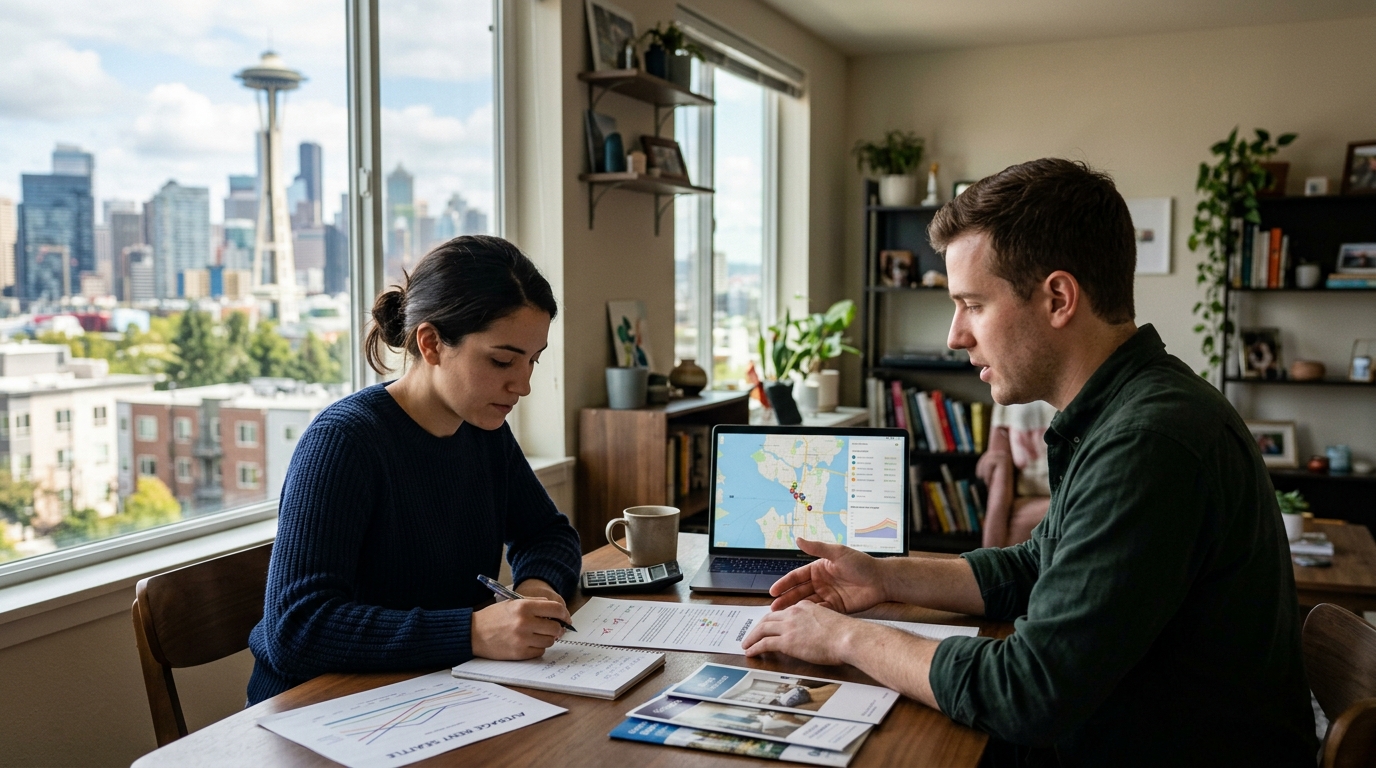
Seattle's typical apartment rents for somewhere between $1,975 and $2,282 a month depending on which tracker you read, and the trackers disagree on direction too: one has the city up about 1.8% over the year, another has it down 2.7%. What you actually pay comes down to unit size, neighborhood, and whether the building is handing out concessions.
This guide sets out the published Seattle figures by unit type and neighborhood, the local supply and rent-law changes sitting behind them, and what each number should change about how you search.
Current Rent Prices by Unit Type
Published averages for Seattle differ by source and by method, so treat any single figure as one reading rather than the price. Year-over-year change is not published by unit size by every tracker; where it is not, the citywide change is the closest guide.
| Unit type | Seattle asking rent | Year-over-year change |
|---|---|---|
| Studio | $1,508/month (Apartments.com (CoStar Group), 2026-10) | Not broken out by size; Seattle rent across all sizes rose 1.8%, about $39/month (Apartments.com (CoStar Group), 2026-10) |
| 1 bedroom | $2,365/month as of late August 2025 (GPS Renting (Real Property Associates), 2025-08) | Up 11% over the prior 12 months in Seattle (same source) |
| 2 bedroom | $2,836/month (Apartments.com (CoStar Group), 2026-10) | An earlier Seattle reading had 2BRs at $2,659, down 6% year over year (GPS Renting (Real Property Associates), 2025-08) |
| 3 bedroom | $3,810/month or more (Apartments.com (CoStar Group), 2026-10) | Three-bedroom single-family houses in Seattle had a $3,695 median in 2025, up 4.1% from 2024 and up 19.4% since 2021 (KIRO 7, citing Rentometer, 2025) |
Across all unit sizes, the citywide numbers spread out like this: Apartments.com (CoStar Group, 2026-10) puts the Seattle average at $2,126 a month, 28% above the $1,666 national average rent; Apartment List (2026-08) puts the Seattle median at $2,083, flat month over month and down 2.7% year over year; RentCafe (2026) reports a $2,253 Seattle average, down 0.89% from $2,273 a year earlier; Zumper (2026-09-29) reports $1,975, down 12% year over year; and Zillow's ZORI (2026-08-18) puts typical rent across the wider Seattle metro at $2,282, up 1.4% year over year.
The spread is mostly a mix of what each source counts — asking rents on new listings versus all active leases, city limits versus the metro, large professionally managed buildings versus every listing type. Use the range, not the midpoint, when you set a budget.
What's Driving the Market
Two local forces explain most of the flatness in the Seattle numbers.
The first is supply catching up to demand, then falling off. Multifamily completions in the Seattle market dropped from 13,654 units in 2024 to a projected 6,725 units in 2025, a fall of 6,929 units or 50.7% (MMG Real Estate Advisors, 2025). But the buildings finished in the earlier wave were still filling: across King and Snohomish counties, roughly 4,110 units were absorbed in the second quarter of 2025 against about 1,524 delivered that quarter, leaving occupancy near 95.9% — roughly 4.1% vacancy (HFO Investment Real Estate, 2025). Lease-up buildings competing for tenants is the clearest reason 52.5% of Seattle-metro listings carried a concession in Zillow's August 2026 reading (Zillow Research, 2026-08-18).
The second is Washington's new rent-cap law. Under HB 1217, the maximum allowable rent increase for 2026 is 9.683%, published through the Washington Department of Commerce HB 1217 Landlord Resource Center (as reported by Utopia Management, 2026-08-20). Separately, landlords in the city of Seattle must give 180 days' notice before raising rent by 10% or more (Steadily, 2026). Together those rules change the timing of renewal offers in Seattle more than the headline number: a large increase has to be signalled roughly six months out, so you usually learn about it with time to shop.
Neither of these is a national story, and neither applies evenly across the city — a 2015 lease-up tower in Denny Triangle and a 1960s fourplex in the south end are in different competitive positions. Nothing here tells you where Seattle rents go next; it tells you why the current readings are close to flat.
Neighborhood Price Comparison
The neighborhood averages below cover all unit sizes, not one-bedrooms specifically — one-bedroom-only medians are not published at neighborhood level by these sources. Compare each against the $2,126 citywide average across all sizes (Apartments.com (CoStar Group), 2026-10).
| Neighborhood | Average asking rent, all sizes | Tradeoff |
|---|---|---|
| Denny Triangle | $3,191/month (Apartments.com (CoStar Group), 2026-10) | The most expensive neighborhood in the city; you are paying for a downtown-core address within walking distance of downtown and South Lake Union offices rather than for square footage. |
| Belltown | $2,350/month, down 4% year over year (Zumper, 2026-06-15) | Downtown-adjacent and walkable to the waterfront, and about $224 a month above the citywide all-sizes average of $2,126. |
| South Lake Union | No separate average published | Grouped with Denny Triangle and Belltown as one of Seattle's three most expensive neighborhoods (Apartments.com (CoStar Group), 2026-10); an office district, so expect pricing in line with Denny Triangle's $3,191. |
| University District | $1,499/month, down 18% year over year (Zumper, 2026-08-25) | Sits next to the University of Washington campus; the 18% drop is the steepest of any neighborhood listed here, and the academic calendar drives turnover timing. |
| Southern Heights-Boulevard Park | $1,358/month (Apartments.com (CoStar Group), 2026-10) | One of Seattle's three most affordable neighborhoods, alongside Brighton and Holly Park (same source); it sits at the city's southern edge, so the tradeoff is a longer trip into downtown. |
The gap between Denny Triangle at $3,191 and Southern Heights-Boulevard Park at $1,358 is $1,833 a month for all-sizes average rent in the same city. Geography is the single biggest lever you control.
What This Means If You're Renting Now
- If your budget tops out near the $2,126 citywide all-sizes average (Apartments.com (CoStar Group), 2026-10), check whether a studio at $1,508 in a central neighborhood or a one-bedroom closer to the $2,365 Seattle average (GPS Renting (Real Property Associates), 2025-08) in a cheaper area gets you the commute you want — the $857 difference between those two Seattle figures usually buys more than a block of location.
- If you are touring buildings that opened in the past two years, ask directly about free weeks or a reduced deposit: 52.5% of Seattle-metro listings carried a concession (Zillow Research, 2026-08-18), so an offer is normal to request, not a reason to lose the unit.
- If you are renewing and the increase is 10% or more, you should have received 180 days' notice under Seattle's rule (Steadily, 2026); if that notice is shorter than 180 days, raise it with the landlord in writing before you sign, and get advice from a Washington tenant attorney or a local tenant services organisation for your specific lease.
- If you need three bedrooms, price apartments and houses separately: Seattle three-bedroom apartments average $3,810 or more (Apartments.com (CoStar Group), 2026-10), while the median three-bedroom single-family house was $3,695 in 2025 (KIRO 7, citing Rentometer, 2025). With both near or above $3,600, start the search earlier than you would for a studio — that end of the market is thin.
- If you are flexible on timing and your current rent is below the $2,083 Seattle median (Apartment List, 2026-08), staying put through a renewal cycle is often the cheaper move, since moving costs are real and citywide rent moved only about $39 a month over the past year (Apartments.com (CoStar Group), 2026-10).
- If you are shopping the University District, note the 18% year-over-year drop in average rent there to $1,499 (Zumper, 2026-08-25) and quote it when you negotiate; a landlord renewing you at last year's number is out of step with that neighborhood's current asking rents.
Frequently asked questions
Why do Seattle rent figures differ so much between sites?
Each source counts different things. Apartments.com reports a $2,126 Seattle average across all sizes (2026-10), Apartment List a $2,083 median (2026-08), RentCafe $2,253 (2026), Zumper $1,975 (2026-09-29), and Zillow's ZORI $2,282 for the wider Seattle metro (2026-08-18). City limits versus metro, and asking rents versus active leases, explain most of the gap.
How much can my landlord raise my rent in Seattle in 2026?
Washington's HB 1217 sets a 2026 maximum increase of 9.683%, published via the state Department of Commerce HB 1217 Landlord Resource Center (reported by Utopia Management, 2026-08-20). In Seattle specifically, 180 days' notice is required before a rent increase of 10% or more (Steadily, 2026). Exemptions exist — check your lease with a Washington attorney.
Should I expect a free month in a Seattle apartment?
It is worth asking. Zillow recorded a 52.5% concession share across Seattle-metro listings (2026-08-18), driven partly by newer buildings still leasing up after completions fell from 13,654 units in 2024 to a projected 6,725 in 2025 (MMG Real Estate Advisors, 2025). Concessions are most common in large new buildings, least common in small older ones.
Is it cheaper to rent a house or an apartment for three bedrooms in Seattle?
The published medians are close. Seattle three-bedroom apartments average $3,810 or more (Apartments.com (CoStar Group), 2026-10), while the median three-bedroom single-family house in Seattle was $3,695 in 2025, up 4.1% from 2024 (KIRO 7, citing Rentometer, 2025). Compare utilities and yard upkeep, which often differ more than the rent.
When should I start looking in Seattle?
That depends on the unit. Studios at the $1,508 Seattle average turn over constantly (Apartments.com (CoStar Group), 2026-10), so four to six weeks out is usually enough. Three-bedrooms near $3,810 are scarcer, so start earlier. In the University District, where average rent fell 18% to $1,499 (Zumper, 2026-08-25), the academic calendar drives supply.
Sources
- Apartments.com (CoStar Group) — Average Rent in Seattle, WA - Latest Rent Prices by Neighborhood (2026-10)
- Zillow Research — Rents Reach $1,962, Rising at the Fastest Pace in Over a Year (July Rent Report) (2026-08-18)

Written by
Maren Vickery
Maren shapes the publication's voice on housing markets and neighborhood change. She's drawn to the gap between how listings describe a place and how it actually feels to live there. Her editing favors plain language over jargon.